Hyaluronic Acid: The Complete Guide to Deep, Lasting Hydration
Introduction
📌 Key Takeaways
✔ Naturally found in the skin and joints
✔ Attracts and retains moisture
✔ Suitable for all skin types
✔ Works best on damp skin
✔ Always follow with a moisturizer
✔ Safe for morning and evening use
If there is one skincare ingredient that has earned its place in the hall of fame, it is hyaluronic acid. Dermatologists swear by it. Beauty editors recommend it religiously. And chances are, you already own at least one product that contains it.
But here is the truth: while hyaluronic acid is everywhere, it is also widely misunderstood. Many people use it incorrectly. Others buy the wrong formulas. And some have even been told that this “miracle hydrator” could actually dry out their skin.
Here is a sobering fact: your body’s natural production of hyaluronic acid drops by approximately 50% by the time you reach age 40. This decline is one of the primary reasons your skin begins to lose its plumpness, elasticity, and youthful glow.
This guide is designed to change all of that. By the time you finish reading, you will understand exactly what hyaluronic acid is, how it works on a molecular level, and—most importantly—how to use it like a true skincare professional.
Table of Contents
1. What Is Hyaluronic Acid?
Let’s start with the basics.
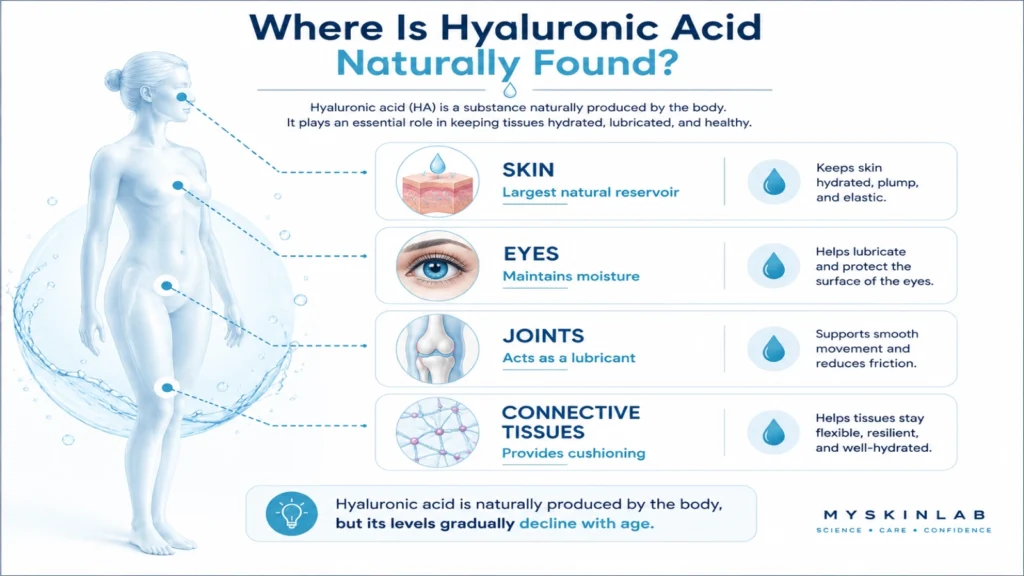
Hyaluronic acid (HA) is a naturally occurring glycosaminoglycan—a fancy scientific term for a long chain of sugar molecules. It is found throughout your body, with the highest concentrations in your:
- Skin
- Joints
- Eyes
Think of hyaluronic acid as your body’s internal sponge. Its most extraordinary property? It can hold up to 1,000 times its own weight in water.
That is not a typo. One gram of hyaluronic acid can bind up to six liters of water. This remarkable ability is what makes it the most powerful humectant known to skincare science.
A humectant, by the way, is simply an ingredient that attracts and retains moisture. And in the world of hydration, hyaluronic acid sits alone at the very top.
2. How Does Hyaluronic Acid Work on the Skin?
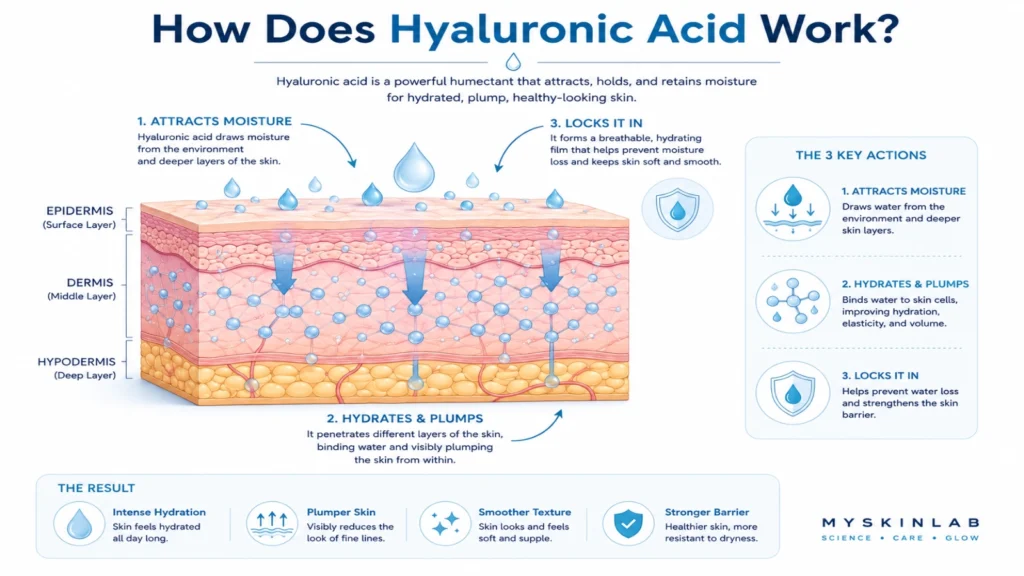
To understand why hyaluronic acid is one of the most effective skincare ingredients, you first need to see how it behaves once it touches your skin. Its unique ability to attract and hold water depends on one important concept: molecular weight.
Multi-Level Hydration
Hyaluronic acid does not just sit on the surface of your skin. It works on two distinct levels:
Surface Hydration
✔ Large hyaluronic acid molecules stay on the skin’s surface.
✔ They form a breathable moisture barrier.
✔ Skin immediately feels smoother.
✔ Gives a healthy glow.
Deep Hydration
✔ Smaller molecules penetrate deeper.
✔ They attract water inside the epidermis.
✔ Skin becomes plumper.
✔ Fine dehydration lines become less visible.
💡 Why Molecular Weight Matters
Not all hyaluronic acid products work the same way. The size of the molecules determines how deeply they can hydrate your skin. Choosing a multi-molecular-weight formula allows hydration at several skin levels instead of only on the surface.
The Critical Role of Molecular Weight
This is the single most important concept to understand about hyaluronic acid. Not all HA is created equal. Its effectiveness depends almost entirely on its molecular size.
| Molecular Weight | Size | Action |
|---|---|---|
| High Molecular Weight | ~2000 kDa | Stays on the skin’s surface. Creates an instant smoothing and hydrating film. Great for immediate glow. |
| Low Molecular Weight | ~50 kDa | Penetrates deeper into the epidermis. Stimulates fibroblasts (cells that produce collagen). Provides deep, long-term hydration and helps reduce deeper wrinkles. |
| Multi-Molecular Weight | Combination | The gold standard. A complex of different sizes that hydrates all layers of the skin simultaneously. |
Pro Tip: When shopping for a hyaluronic acid serum, always look for a formula that contains a Multi-HA complex. This ensures you are getting both the immediate surface benefits and the deeper, long-term anti-aging effects.
Now that you understand why molecular weight matters, let’s explore the real-world benefits you can expect from using hyaluronic acid consistently.
3. Proven Skin Benefits
The scientific literature on hyaluronic acid is vast and overwhelmingly positive. Here are the key, clinically-proven benefits you can expect from consistent use:
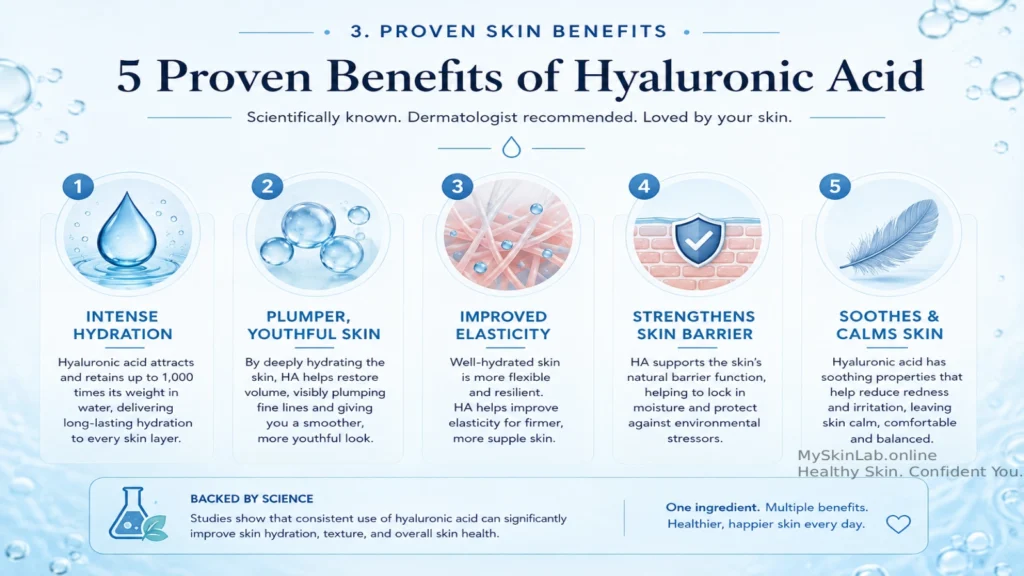
- Intense Hydration: This is the primary benefit. HA restores and maintains optimal moisture levels in the skin.
- Plumping Effect: By attracting water, HA visibly fills in fine lines and wrinkles caused by dehydration.
- Improved Elasticity: Hydrated skin is bouncier and more supple. HA helps restore that youthful resilience.
- Barrier Reinforcement: A well-hydrated stratum corneum (the outermost skin layer) is a strong barrier. HA helps protect your skin from environmental aggressors.
- Wound Healing: HA plays a crucial role in tissue repair. It creates a moist environment that promotes faster healing.
- Soothing Properties: HA has anti-inflammatory benefits, making it excellent for calming irritated or reactive skin.
4. Is HA Right for You? Skin Types & Use Cases
One of the most beautiful things about hyaluronic acid is its universal compatibility. It works for virtually every skin type. However, the formula you choose should match your specific needs.
Dry Skin
Verdict: An absolute must-have.
Why: Dry skin lacks both water and oil. HA provides the deep water infusion it craves. Look for richer, cream-based formulations to combine hydration with nourishment.
Dehydrated Skin
Verdict: The ultimate solution.
Why: Dehydrated skin lacks water, not oil. It is a condition, not a skin type. HA directly addresses this by flooding the skin with moisture. A lightweight serum or gel formula works best.
Oily & Combination Skin
Verdict: A fantastic ally.
Why: Many people with oily skin mistakenly avoid moisturizers. This is a critical error. Dehydrated oily skin produces more oil to compensate for a lack of water. HA serums provide the hydration your skin needs without clogging pores or leaving a greasy residue.
Sensitive Skin
Verdict: Extremely well-tolerated.
Why: Since HA is naturally produced by your body, it is highly biocompatible and rarely causes irritation. It is often recommended by dermatologists for patients with eczema, rosacea, or reactive skin.
5. How to Use Hyaluronic Acid (The Golden Rules)
Using hyaluronic acid incorrectly is one of the most common skincare mistakes. Here is how to do it right, every single time.
Golden Rule #1: Apply to Damp Skin
This is non-negotiable.
Hyaluronic acid is a humectant. It attracts water. If you apply it to dry skin, it will pull moisture from the deeper layers of your skin up to the surface, where it will simply evaporate. This can actually leave your skin more dehydrated than before.
The Fix: After cleansing, do not dry your face completely. Leave it damp. Spray a facial mist or thermal water if needed. Then, apply your HA serum on this damp canvas. The HA will grab onto that surface water and pull it into your skin.
Golden Rule #2: The “Sandwich” Technique
A humectant without an occlusive is like a bucket with a hole in it.
After applying your HA serum to damp skin, you must immediately follow with a moisturizer. This cream acts as an occlusive layer—a “lid” that seals the moisture in and prevents it from evaporating. This technique is called the “sandwich method” and it is the secret to maximizing HA’s efficacy.
Golden Rule #3: Morning and Night
Hyaluronic acid is safe and effective for use twice daily. Use it in the morning to plump and prepare your skin for makeup. Use it at night to support your skin’s natural repair cycle.
Golden Rule #4: Don’t Forget the Eye Area
The skin around your eyes is thinner and more prone to dehydration. A dedicated hyaluronic acid eye cream or serum is an excellent investment for maintaining a smooth, youthful eye contour.
6. Best Ingredients to Pair with Hyaluronic Acid (Synergy)
Hyaluronic acid is a team player. It works beautifully with virtually every other skincare active. Here are the power duos you need to know about.
HA + Vitamin C
- Why it works: Vitamin C is a potent antioxidant that brightens, evens skin tone, and protects against environmental damage. HA provides the hydration that keeps the skin healthy and resilient. Together, they deliver a radiant, glowing complexion.
- Best for: Morning routine.
HA + Retinol
- Why it works: Retinol is the gold standard for anti-aging, but it can be drying and irritating, especially for beginners. HA is the perfect buffer. It hydrates the skin, soothes potential irritation, and supports the skin barrier during the retinization process.
- Best for: Evening routine. Layer HA serum first, wait a few minutes, then apply your retinol, and finish with a rich moisturizer.
HA + Niacinamide
- Why it works: Niacinamide (Vitamin B3) strengthens the skin barrier, reduces inflammation, and minimizes pores. When paired with HA, you get a super-hydrating, barrier-boosting cocktail that is ideal for sensitive or acne-prone skin.
- Best for: Any routine, morning or evening.
HA + Exfoliating Acids (AHA/BHA)
- Why it works: Exfoliating acids dissolve the bonds between dead skin cells to reveal fresh, new skin underneath. This process can temporarily compromise the skin barrier. HA is the perfect post-exfoliation step to soothe, calm, and rehydrate the skin.
- Best for: Evening routine on exfoliation nights.
7. Are There Ingredients to Avoid with HA?
The short answer: No.
Hyaluronic acid is one of the most docile, compatible, and non-irritating skincare ingredients ever discovered. It does not conflict with any other active ingredient. It does not have a pH restriction. It is simply a hydrating molecule that plays well with everyone.
The only thing you need to avoid is using it incorrectly (i.e., on dry skin without a moisturizer on top). The ingredient itself is not the problem; the application method is.
8. Side Effects & Common Myths
Myth #1: Hyaluronic Acid Can Dry Out Your Skin
- The Claim: In dry climates, HA will pull water from your skin instead of the air, causing dehydration.
- The Truth: This is partially true, but completely avoidable. If you live in an arid environment and you apply HA to dry skin without sealing it with a moisturizer, it can draw moisture from the deeper layers of your skin. However, if you follow the golden rules (apply to damp skin, and seal with an occlusive), this will never happen. The water is locked in, not evaporating out.
Myth #2: Topical HA Works Like a Filler
- The Claim: Using an HA serum will give you the same results as a dermal filler injection.
- The Truth: Absolutely not. Topical HA deeply hydrates and plumps the skin, smoothing out fine lines and improving texture. However, it is a temporary humectant. It does not add volume or restructure the face. Dermal fillers are injectable gels that physically fill wrinkles and add volume to areas like the cheeks and lips. They are a completely different category of treatment.
Actual Side Effects
Topical application of hyaluronic acid is considered extremely safe. The molecule itself is non-comedogenic (does not clog pores) and non-irritating. The rare side effects people experience (redness, itching, breakouts) are almost always caused by other ingredients in the formulation, such as:
- Fragrances
- Essential oils
- Certain preservatives
Always patch-test new products to rule out any sensitivities to these secondary ingredients.
9. Common Mistakes to Avoid
Let’s recap the most frequent errors people make with hyaluronic acid so you can avoid them completely.
- Applying to Completely Dry Skin: The number one mistake. Always start with a damp face.
- Skipping the Moisturizer: Using HA without sealing it with a cream is a waste of product and can backfire.
- Using a Formula with Only One Molecular Weight: You miss out on the multi-depth benefits. Look for “Multi-HA” or “low + high molecular weight” on the label.
- Believing HA is a One-Step Solution: HA is incredible for hydration, but it is not a multi-tasking hero. It does not exfoliate, brighten, or fight free radicals on its own. It needs to be layered with other actives for a complete routine.
- Applying Too Much Product: A few drops of serum or a pea-sized amount of moisturizer is all you need. More product does not equal more hydration.
10. Frequently Asked Questions (FAQ)
Is Hyaluronic Acid the Same as Sodium Hyaluronate?
They are related but not identical.
Hyaluronic Acid: The naturally occurring molecule.
Sodium Hyaluronate: The sodium salt form of hyaluronic acid. It is more stable and has a smaller molecular weight, which allows for better skin penetration. Most skincare products use sodium hyaluronate because it is more cost-effective to produce and has a longer shelf life.
Both are excellent. If you see “sodium hyaluronate” on an ingredient list, you are still getting the benefits of hyaluronic acid.
Can I Use Hyaluronic Acid Every Day?
Yes. In fact, you should. Consistent, twice-daily use (morning and night) is recommended for optimal results.
Is Hyaluronic Acid Effective on Deep Wrinkles?
It will visibly improve the appearance of deep wrinkles by plumping the skin and filling them in from within. However, its primary strength is on fine lines caused by dehydration. For deeper, established wrinkles, a combination approach with retinol, peptides, and professional treatments is more effective.
Can I Use Hyaluronic Acid During Pregnancy?
Yes. Topical hyaluronic acid is considered completely safe for use during pregnancy and breastfeeding. It does not enter the bloodstream. It is often recommended to help combat the skin dryness that many women experience during pregnancy.
What Does “Hydraulic Acid” Mean?
Nothing. “Hydraulic acid” is a common misspelling or mistranslation of “hyaluronic acid.” If you see this term, it is a red flag for an unprofessional product.
🧠 Before You Leave: 60-Second Memory Card
Short on time? Spend just one minute reviewing this Memory Card to reinforce the key concepts from this guide.
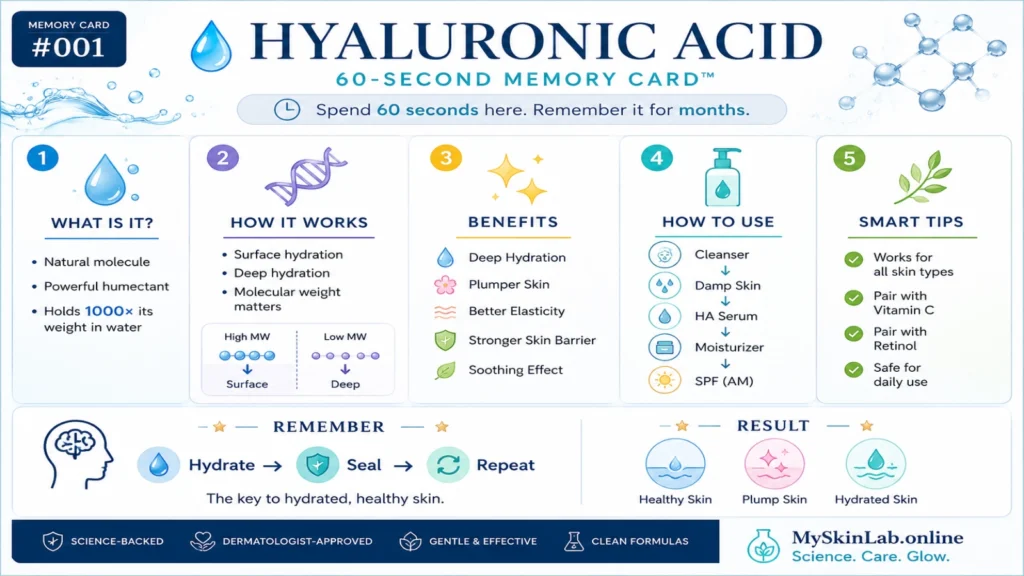
Part of the MySkinLab Memory Card™ Collection
Memory Card #001 – Hyaluronic Acid
Conclusion & Final Verdict
Hyaluronic acid is not a marketing fad. It is not an overhyped trend. It is a scientifically-proven, biologically-sound, and universally-effective hydrating agent that should be a cornerstone of every skincare routine.
The secrets to unlocking its full potential are simple but powerful:
- Choose a high-quality formula with a Multi-Molecular Weight complex.
- Apply it correctly – on damp skin, sealed with a moisturizer.
- Use it consistently – twice daily, paired with complementary actives like Vitamin C and Retinol.
Whether your skin is dry, oily, sensitive, or somewhere in between, hyaluronic acid has something to offer you. It is the closest thing to a skincare universal solvent—an ingredient that works with your biology to deliver visible, reliable, and lasting results.
Your skin deserves deep hydration. Now you have the knowledge to provide it.